
This article appeared in the October 2013 issue of the USBF Western Sector Newsletter.
The idea for this month’s article came from several players who had some questions about the centerline. On many synthetic courts there are two centerlines. Some players are confused not only by the double centerline layout but also by all the other lines on the court.
The double centerline question is the first item I would like to explain. Most synthetic courts are laid out for the sport of punto, raffa, volo (raffa) even though open is the most popular form of bocce that is played on these courts. An official raffa court is 26.5 meters in length (86’-11”). Courts also can vary in length from 24.5 meters to 27 meters but the 26.5 meter length is the ideal length. In reality, not all courts are constructed exactly to this distance. Sometimes the physical limitations of the building or site govern the length of the court. Another reason is that sometimes the swinging backboards were not factored into the design of the court. They take up 3 to 6 inches of space at each end of the court. The centerline of an official raffa court lies at a distance of 13.25 meters (43’-5-1/2”) from the backboard. Since the centerlines on a raffa court are based on the measurement from each backboard, two lines will be required on courts that do not measure 26.5 meters from backboard to backboard.
This sounds simple so far. The question that was posed asked: “Does the second centerline ever come into play during a frame?” In one instance, the pallino was hit, struck another ball, and entered the space between the two lines. Some of the players said that because the pallino moved in the opposite direction of play the second line should be used. In this situation the frame is nullified and play starts at the opposite end because the pallino crossed the original centerline that was in play for the frame. There is only one centerline in a given frame. When play begins on the opposite end the other centerline is in play.
The discussion so far deals with a theoretical line with no width. Courts are generally marked with painted lines about one inch wide. The next question asked was: “Where is the actual centerline when the pallino lands on or close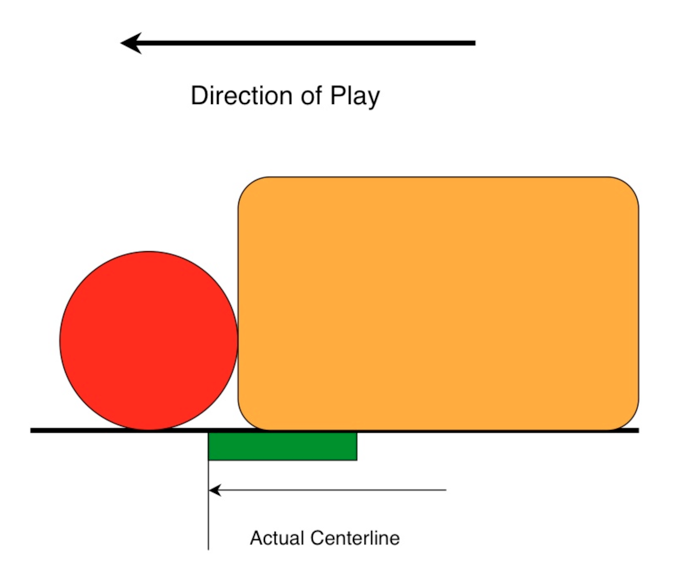 to the painted line?” The answer is that the farthest edge of the painted line in the direction of play is used to determine if the pallino has passed or cleared the line at the start of the frame, or in the situation described above when the pallino moved in the opposite direction of play. A good way to determine if the pallino is valid is to place a credit card or similar rectangular card on the farthest side of the painted line. If it does not touch the pallino, the pallino is valid. If the vertical projection of the pallino’s circumference or “equator” enters the painted area of the line then the frame is nullified. The drawing indicates an invalid pallino. It is invalid because the projection of the pallino touches the painted area of the line. In the drawing, the green represents the painted line on the court, the red is the pallino and the gold is someone else’s credit card.
The second most popular question that relates to lines is: “What are all the other lines for if we don’t use them in open?” The answer can be found in detail by looking at the rules for raffa on the USBF website. Since this article is about lines and more lines, a short description is in order. In raffa the lines are labeled A, B, C, D, and E.
 Line A is the backboard. Line B is 4 meters (13’-1-1/2”) from the backboard and is the line used to lag or make a raffa shot. The B line is also the same line that is used to lag or make a raffa shot in the game of open. In raffa, the B line on the far end of the court is the maximum distance the pallino can be rolled at the start of a frame. The C line is 7 meters (22’-11-1/2”) from the backboard and is the line from which a player can make a volo shot. A volo shot is lofted in the air and must strike the target ball or pallino inside an arc that is 40 centimeters (15-3/4”) in front of the declared target ball or pallino. The D line is 9 meters (29’-6-1/4”) from the backboard and is the line that a raffa shot must pass before hitting the court’s surface. Also, any ball between the centerline and the D line on the other side of the centerline or between the two D lines can only be shot using the volo technique. If a ball is less than 13 centimeters (5-1/8”) from the pallino it can be struck with a raffa shot. The last line is called the E line and is the centerline. I think that it is appropriate to end this discussion with the centerline since that is where we started!
 Ross On Rules